
Review · THE GOLD COAST
Gold Coast Tandem Skydive
The beach becomes your runway. This Gold Coast tandem jump combines a short burst of freefall with calm parachute views over the coast, ending on white sand at Kirra Beach. I like the beach landing and the chance to see the Gold Coast and Pacific Ocean from above. I also like the small maximum group size of five, which should make the ground process feel more personal. The main drawback is that weather and airport air-traffic rules can change your jump time or altitude.
At $355.04 per person, this is a serious spend, but it includes training, the jump, beach landing, taxes, and your certificate. Photos and video cost extra, so budget for those if you want a record of the experience. You must also pay close attention to the weight rules and the 24-hour gap required after scuba diving.
Key things to know before your tandem jump
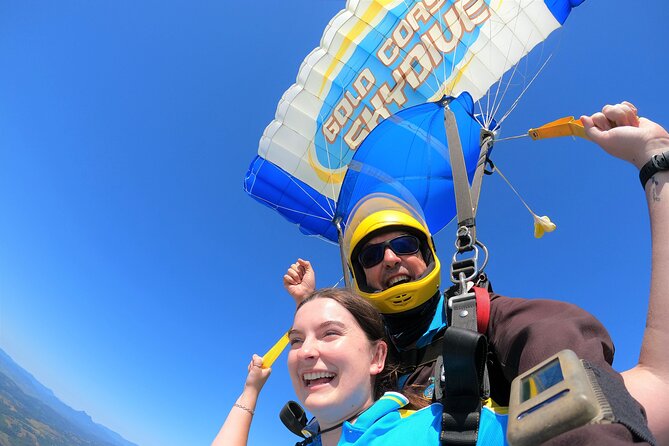
- You jump from up to 12,000 feet: The scheduled height is 12,000 feet, though airport air-traffic control can limit some jumps to 10,000 feet.
- Freefall lasts about 45 seconds: After that, your instructor opens the parachute for a gentler four to five-minute descent.
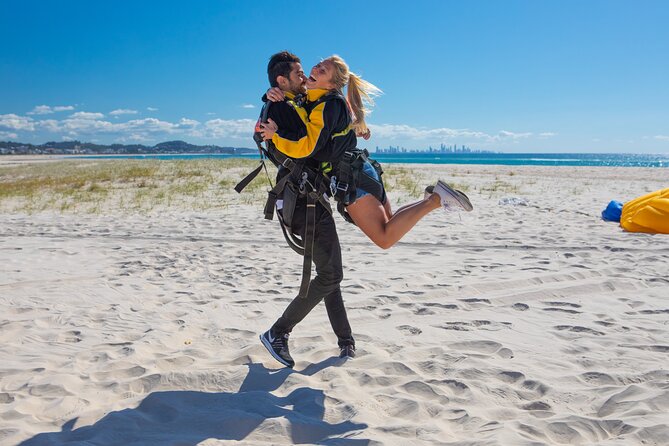
- You land on Kirra Beach: The final approach ends on soft sand, a memorable finish beside one of the Gold Coast’s best-known beaches.
- Training takes about 15 minutes: You learn how the harness works, how to leave the aircraft, and how to position your body.
- The maximum listed weight needs clarification: The description says 95 kilograms, while the additional information gives an absolute maximum of 115 kilograms. Contact the operator before booking if you weigh over 95 kilograms.
- Weather can change the plan: Poor conditions may lead to a new date or a full refund, but a cancellation inside 24 hours normally is not refundable.
Why the Kirra Beach finish matters
Many tandem jumps end at an ordinary landing area. Here, the final moments take place on Kirra Beach, where the soft sand and coastal setting give the experience a proper Gold Coast finish.
You do not simply return to the ground and walk away. You touch down beside the Pacific, receive a jump certificate, and finish near the same beach that framed much of the view from above. That sense of place adds real value, especially if this is your main adventure activity during a Gold Coast holiday.
The beach landing is also a practical feature. Sand is a softer, more appealing setting than a plain field, though you should still follow your instructor’s directions closely during the landing. The experience is built around a tandem harness, so your instructor manages the parachute and the technical work.
Kirra Beach is the first named stop, but it is really the final scene. The jump itself begins elsewhere, at the Gold Coast Skydive operation on Coyne Street in Coolangatta.
More Tandem Skydives in Australia:
- Airlie Beach: Tandem Skydive over the Whitsundays
★ 4.8 · 726 reviews - Airlie Beach: Tandem Skydiving Experience with Beach Landing
★ 4.9 · 382 reviews - Cairns: Tandem Skydive Experience
★ 4.9 · 282 reviews
Starting at 18 Coyne Street in Coolangatta
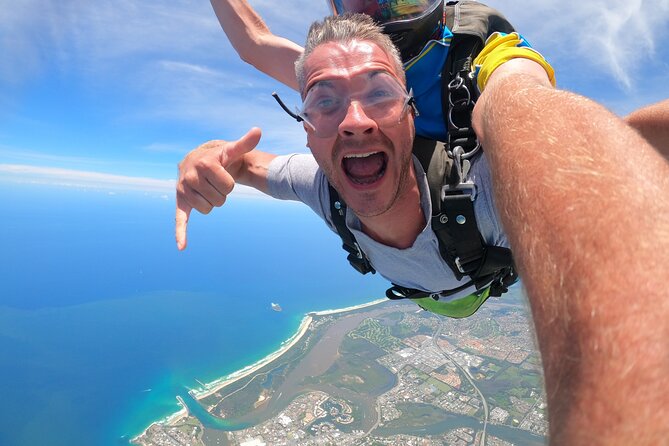
Your meeting point is 18 Coyne Street, Coolangatta, Queensland 4225. The activity takes about two and a half hours from start to finish, though the exact pace can depend on weather, airport operations, and the number of people jumping that day.
The group size is capped at five people. That is useful for an activity that can feel intimidating before it begins. A small group usually means less standing around and more direct attention during the preparation, although the overall timing can still shift if conditions change.
The operation is close to the airport, and the aircraft takes off from the international airport. A short bus ride to the airport is part of the process, according to the practical description of the experience. At the meeting point, you handle the initial preparation before heading to the aircraft.
Several flight times are available, so you can fit the jump around other Gold Coast plans. I would avoid booking anything tightly timed afterward. A weather delay, a change in flying conditions, or airport control can affect the schedule.
The activity returns to the meeting point at the end. Transportation beyond the stated airport transfer is not included, so plan your route to Coyne Street independently.
The 15-minute lesson before takeoff
The training session lasts about 15 minutes. It covers the equipment, freefall technique, how to leave the aircraft, and what to expect during the descent.
That short lesson matters. You do not need to master parachute control, since your instructor handles that part, but you do need to understand the body position and landing instructions. Nervousness is normal, and the staff’s job is to make the process clear before you reach the plane.
The instructors are often praised for combining professionalism with humor. Names that come up in the experience include Adam, Germain, Rolly, Luke, Mike, and James. Several people credit their instructor with helping them relax, especially at the aircraft door and during the first seconds of freefall.
Luke, in particular, is described as calm and experienced, with 15 years in the sport. Adam is praised for making a first jump feel safe and controlled. Germain, also known as Frenchy, receives warm praise for his friendly approach. These personal touches matter because the instructor is attached to you for the entire jump.
You will be securely harnessed to your instructor before entering the aircraft. Listen carefully, ask questions, and do not be embarrassed if you need instructions repeated. This is not the moment to pretend you are calmer than you feel.
The climb to 10,000 or 12,000 feet
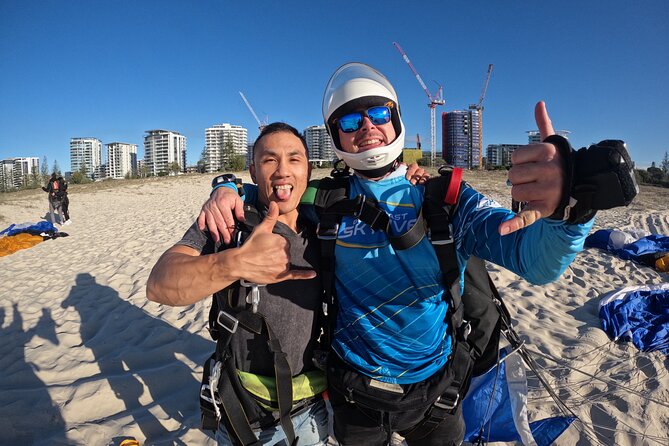
The aircraft climbs from the airport toward your exit height. The advertised height is 12,000 feet, but the actual altitude can vary.
Airport air-traffic control determines the height available for each flight. The operator gives a minimum of 10,000 feet and a maximum of 12,000 feet. One participant was disappointed by a jump from about 10,200 feet after expecting 12,000, but the operator explained that flights near an international airport are subject to air-traffic restrictions.
That detail is worth understanding before you pay. A jump from 10,000 feet is still a major experience, but it offers less time in freefall than a jump from 12,000 feet. If the exact height matters to you, ask about the day’s operating limits rather than assuming the maximum is guaranteed.
The climb gives you time to look around. You can see the Gold Coast, the coastline, the beaches, and the Pacific Ocean from the aircraft. The views begin before the jump, which helps make the ascent feel like part of the experience rather than simply a wait for the main event.
More Skydives in Australia:
- Rottnest Island Tandem Skydive
★ 5.0 · 258 reviews - Airlie Beach Tandem Skydive Over the Whitsunday Islands
★ 4.5 · 255 reviews - From Sydney: Tandem Skydive Experience over Beach
★ 4.7 · 234 reviews - Sydney: Tandem Skydive with Optional Transfers
★ 4.8 · 202 reviews
Forty-five seconds of freefall
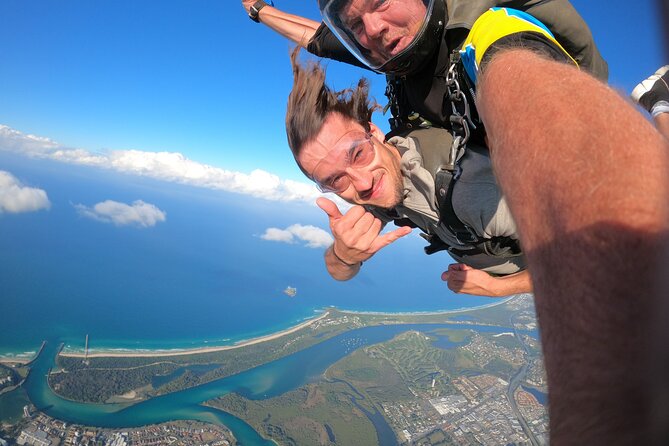
At the exit height, your instructor prepares you at the aircraft door. Then you leave the plane together.
The freefall lasts about 45 seconds and reaches roughly 220 kilometers per hour. That is fast enough to overwhelm your senses at first. One person described closing their eyes and tumbling briefly before the instructor helped them settle into position. This is why the training and the instructor’s guidance matter.
Your main job is to follow instructions, keep your body in the required position, and stay aware of your instructor’s signals. The initial rush can be intense, but it passes quickly. The experience then changes character once the parachute opens.
The views are not limited to a quick look at the beach. You may see white clouds, long stretches of coast, the Gold Coast skyline, and open ocean. One particularly memorable account describes spotting whales breaching from above, though that is a lucky possibility rather than something you should expect on every jump.
Four to five quiet minutes under the parachute
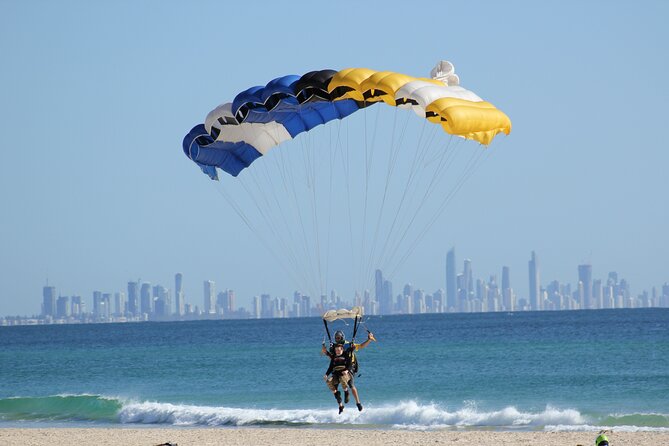
After freefall, your instructor deploys the parachute. The pace slows sharply, giving you four to five minutes to take in the scenery.
This is the part I think many first-time jumpers underestimate. The freefall is the headline, but the parachute section gives you time to understand where you are. You can look down at the beaches and coastline without the same rush, while your instructor manages the descent.
You may also have more time to talk with your instructor during this stage. That can turn the flight into a more relaxed shared experience after the intensity of the exit and freefall.
The contrast is one of the strongest parts of the activity: a short, loud, fast fall followed by a slower view of the Gold Coast from the air. If you want only a burst of adrenaline, the freefall delivers it. If you care about scenery, make sure you keep your eyes open during the parachute ride.
Landing on Kirra Beach and receiving your certificate
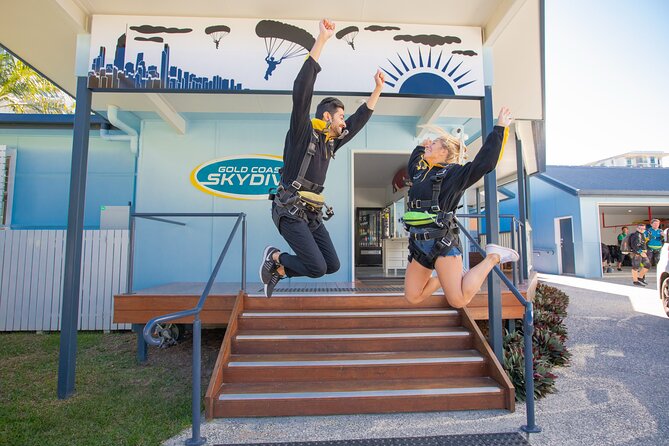
The descent ends at Kirra Beach. Your instructor controls the approach and gives you the landing directions you learned during training.
The beach setting is especially good for photographs, but the standard package does not include photos or video. Those options are available when you arrive at the office and cost extra. If you think you will want a record of the jump, decide before takeoff rather than trying to make the choice afterward.
The jump certificate is included. It is a small but useful souvenir, particularly if this is your first time leaving a plane. The activity then finishes back at the meeting point.
Is $355.04 good value?
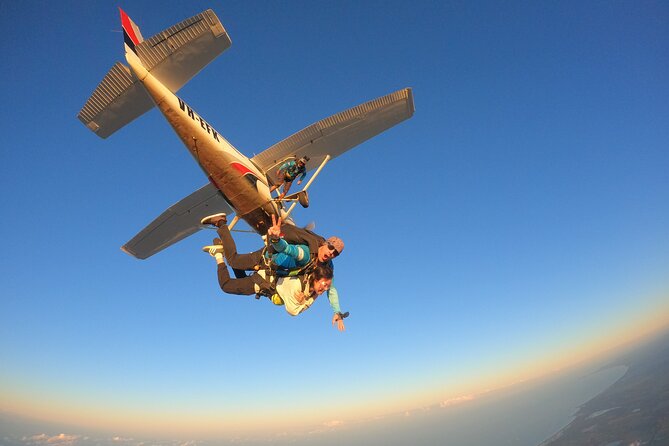
At $355.04, this is not a cheap Gold Coast attraction. You are paying for specialist staff, aircraft time, equipment, training, insurance-related operating costs, the beach landing, and the full two-and-a-half-hour experience.
The price makes more sense if you treat the jump as a major holiday event rather than a casual activity between beach visits. You receive the training, tandem jump, landing, taxes, and certificate. You do not pay separately for the basic activity components listed above.
The extra cost is the media package. Photos and video are available on arrival, but they are not included in the stated price. That can push the final bill higher, so include it in your budget if you want proof of the jump.
The small group limit also helps the value. A maximum of five people creates a more personal setting than a large commercial group, though it does not guarantee a quick departure. Weather and air-traffic control remain outside the operator’s control.
Safety, weather, and the details that matter
This is an outdoor aviation activity, so good weather is required. If poor conditions cancel the jump, you can be offered another date or a full refund.
You can cancel for a full refund if you do so at least 24 hours before the start time. A cancellation less than 24 hours before the activity is normally not refundable, and changes inside that period are not accepted. If the operator cancels for weather, that rule is different, and you can choose a new date or a refund.
There is one important scuba rule. You must leave at least 24 hours between your last scuba dive and this tandem jump. You can take the tandem jump first and scuba dive afterward, so plan the order carefully if both activities are part of your holiday.
Weight information needs special attention. The main description lists 95 kilograms as the maximum for the experience, while the additional information says people over 95 kilograms must contact the operator and gives a maximum of 115 kilograms. Because these figures are not identical, contact Gold Coast Skydive before booking if you weigh more than 95 kilograms.
Service animals are allowed, and the activity is near public transportation. Most people can participate, but you should still raise any personal concerns with the operator before booking.
Who will enjoy this Gold Coast jump?
I would recommend it to you if you want one major thrill during a Gold Coast holiday and like the idea of combining adrenaline with coastal views. It suits first-timers particularly well because the instructors explain the process and stay connected to you throughout the jump.
It is also a good choice for a birthday surprise or a personal milestone. One jump was arranged as an 18th birthday gift, and another included a special surprise. The staff appear comfortable helping make the occasion memorable, though you should discuss special plans with them ahead of time.
You may want to skip it if your schedule cannot handle a delay, if you are uncomfortable with the weight limits, or if $355.04 is already stretching your holiday budget. You should also think twice if you want a guaranteed 12,000-foot exit, since airport restrictions can reduce the altitude.
Should you book the Gold Coast Tandem Skydive?
Book it if you want a well-supported first jump, a spectacular coastal setting, and the unusual finish of landing on Kirra Beach. The strongest reasons are the professional instructors, the short but powerful freefall, and the peaceful parachute ride with views over the Gold Coast and Pacific Ocean.
Before paying, confirm your weight eligibility, ask about the likely jump height, and decide if you want the photo and video package. Leave room in your schedule for weather changes, and do not place a scuba dive within 24 hours before the jump.
For a once-in-a-holiday adventure, this is a strong choice. It costs more than a standard sightseeing activity, but the beach landing and aerial views give it a clear sense of place.
FAQ
How long does the Gold Coast tandem jump take?
The full experience takes approximately two hours and 30 minutes.
Where does the experience start?
It starts at 18 Coyne Street, Coolangatta, Queensland 4225, Australia.
Where does the jump finish?
The jump lands on Kirra Beach, and the activity ends back at the meeting point.
How high do you jump from?
The planned exit height can reach 12,000 feet. Air-traffic control may limit some flights to 10,000 feet, and the stated minimum is 10,000 feet.
How long is the freefall?
The freefall lasts approximately 45 seconds.
How long is the parachute descent?
After the parachute opens, the descent takes about four to five minutes.
Is training included?
Yes. Ground training is included and takes approximately 15 minutes.
Are photos and videos included?
No. Photo and video packages are available for an additional cost when you arrive at the office.
What is the weight limit?
The information lists 95 kilograms as the point at which you should contact the operator, and gives 115 kilograms as the maximum. Contact Gold Coast Skydive if you weigh over 95 kilograms.
Can I jump after scuba diving?
You need a 24-hour gap after your last scuba dive before taking the tandem jump. You can take the jump first and scuba dive afterward.
What happens if bad weather cancels the jump?
You can be offered another date or a full refund if poor weather causes the cancellation.
Can I cancel my booking?
You can cancel at least 24 hours before the start time for a full refund. Cancellations or changes made less than 24 hours before the experience are not accepted for a refund.
Just added around Australia
- Rottnest Skydive + Hillarys Ferry package★ 5.0 · 20 reviews
- Rottnest Skydive + Perth Barrack St Ferry package★ 5.0 · 11 reviews
- Noosa: Tandem Skydive Experience★ 4.0 · 16 reviews
- Rottnest Island Skydive Including Round Trip Ferry from Fremantle★ 4.5 · 3 reviews
- Coffs Harbour Ground Rush or Max Freefall Tandem Skydive on the Beach★ 5.0 · 11 reviews
- SA Skydiving Adelaide – Goolwa★ 4.5 · 9 reviews
- Sydney, Shellharbour: 15,000ft Tandem Beach Skydive★ 4.8 · 6 reviews
- Sunshine Coast: Tandem Skydive with Beach Landing★ 5.0 · 19 reviews
Tandem Skydives, compared.
Tandem Skydiving Experience with Beach Landing
Read our review →
15,000ft Tandem Skydive in Tauranga – Bay of Plenty
Read our review →Browse the lists this tour appears in